Sometimes you have to stop and ask yourself: "What the fuck am I doing and why?"
The answer, rarely, is traveling on a convoluted bus route cobbled together from Reddit posts, YouTube videos, and local transit websites designed in the early 2000s and never looked at again. Because apparently life isn't hard enough.
This is by far not the most absurd version of this story. Adam did this from San Francisco to Seattle, and Miles In Transit (god amongst men) did this from Mexico to Canada—both significantly longer, more grueling trips with far more at stake over a missed connection than I. Unfortunately for me, I was also running on constraints of time and budget as they related to my part-time employment, so taking a week off to subject myself to interstate travel via public transit over the holidays, while tempting, wasn't excusable.
Some context. I like transit an abnormal amount for a neurotypical person, but an average amount for an autistic person. Being autistic, I, of course, wanted to make use of this average enjoyment of public transit, and thankfully there are many other autistic people who also have an average love of public transit, who enjoy sharing that. Not that it's a prerequisite to be autistic if you like buses a lot, but you have to have something going on with you if you think this is a good and fun idea.
And it is. It is a fantastic idea—but I also have many things going on with me.
Okay I'm writing in circles. What is this about?
I traveled from Portland to Seattle entirely using local public transit—that is, city and county bus systems. No Greyhound, no Amtrak. A trip which takes roughly three to three and half hours by car or Amtrak train, took me a little less than eight using this method. Some might call it unnecessarily involved. Those people are correct. They are also killjoys who don't understand what it means to do something for the love of the game. This journey was a challenge of my own patience, concentration, and a test of my will, and the will of the Washington state bus systems. Which, I discovered, are actually pretty fucking sick.
If you live in a place where this is possible and safe, I highly recommend doing something like this. It doesn't need to cross state lines, it doesn't even need to be a trip where you end somewhere different than where you started. I've seen local transit nerds creating and riding circular routes that maintain a level of whimsy, and allow you to really enjoy the privilege of a good transit system. Go. Be free. But first, a word to the wise.
Always plan ahead.
The Game Plan
I started this trip, arguably, in a spreadsheet. I kept the spreadsheet as a trophy, but also because it's reusable. Unless something major changes, the route will always be the same, and I intend on extending into California when I can. Building off of what I already have charted for Seattle to Portland—and vice versa—makes future me's life infinitely easier. To give credit where credit is due, past me's life was made infinitely easier by this post on Reddit which laid out 99% of what I needed. Basically the entire trip, with an addendum that one of the routes changed numbers.
Of course, the story doesn't end with Reddit (it doesn't even start there, I mentioned offhandedly about Adam and Miles in Transit. Their videos were what really inspired this trip, and I referred back to them multiple times to double check my work, and in preparation for what the day itself would look like).
I copied the route from the Reddit post into my spreadsheet, at this point looking rather barebones. The route traveled from Portland to Seattle—up not down—and detailed the basics of what buses to take and where to connect, but didn't conveniently detail departure or arrival times, cost, or time traveled. Also, initially, I planned on running this route inversely—Seattle to Portland—so I had to flip the schedule in my first draft spreadsheet.
Without knowing what times buses arrive or leave, I could easily strand myself by timing a connection incorrectly at the end of the day, missing the last bus home. I couldn't accurately account for how long each ride would take in my head (sadly), so having that calculated in advance mattered a lot too. Cost, while not as immediately important, was still something to consider, especially getting into more rural areas. The greater Seattle area operates on a unified system of Orca cards—like New York's METRO card, may it rest in peace. Outside of Seattle, however, is a different story, and one which I'll get into later as I detail the legs of my trip. Suffice to say, some bus systems take cash, some take card, some take nothing at all, and knowing how much cold hard cash to bring with me so I could pay for my rides was important, but not urgent.
So I got to work. With a basic outline, I put some meat on those bones, and began by organizing my spreadsheet as pictured (start time and location censored for some facsimile of privacy).

I wanted two things. Easy legibility from a small screen (IE: my phone), and enough information at a glance so that I wouldn't need to fight with Google in the middle of nowhere, or risk missing a connection to double check my work.
Route name is self explanatory, I specifically tried to coordinate it with what would be shown on the bus destination displays, that way I could look at my phone, then at the bus, and know immediately if it was the right one or not.
Time of start refers to the time the bus is scheduled to depart from the stop I'd be catching it at, while time of end refers to the time that bus is scheduled to arrive at the stop I'd be getting off at. I used this to calculate estimated transfer time, using the difference between the previous time of end and the proceeding time of start. So, say, the 594 arrives at SR 512 Park and Ride at 6:54 AM. From there I intend on catching the 610 at 7:17 AM. From the time I arrive off the 594, to the time the 610 arrives and departs, there are 16 minutes. Therefore, generously, I have a margin of error within 16 minutes before I risk missing the bus at 7:17. For longer transfers, it allowed me to plan ahead and build in lunch breaks—see the 50 minutes I had in Olympia (OTC) while waiting for the Green line. Or the 1 hour gap at Longview.
Listing start and end aren't just useful for planning transfers, seeing as I was entirely unfamiliar with these bus routes, cities, etc. I would need a quick and easy way to know when to ding the bell to be let off—and in some cases, tell the bus driver before I got on the bus what stop I intended to depart at. We will broach the surreal experience of rural bus routes later.
Not pictured: the table for cost.
How did I find this information? It certainly wasn't in the Reddit post (that post had times, but not the times I needed, and I'd want to do the work myself to be sure it was up to date anyways). Let me show you the wonderful world of local transit authority websites. Come. Take my hand. This is not the internet of Elon Musk's neo-nazi glamour project, or $5 subscription fees to a streaming service called Glooble. This. This is art.
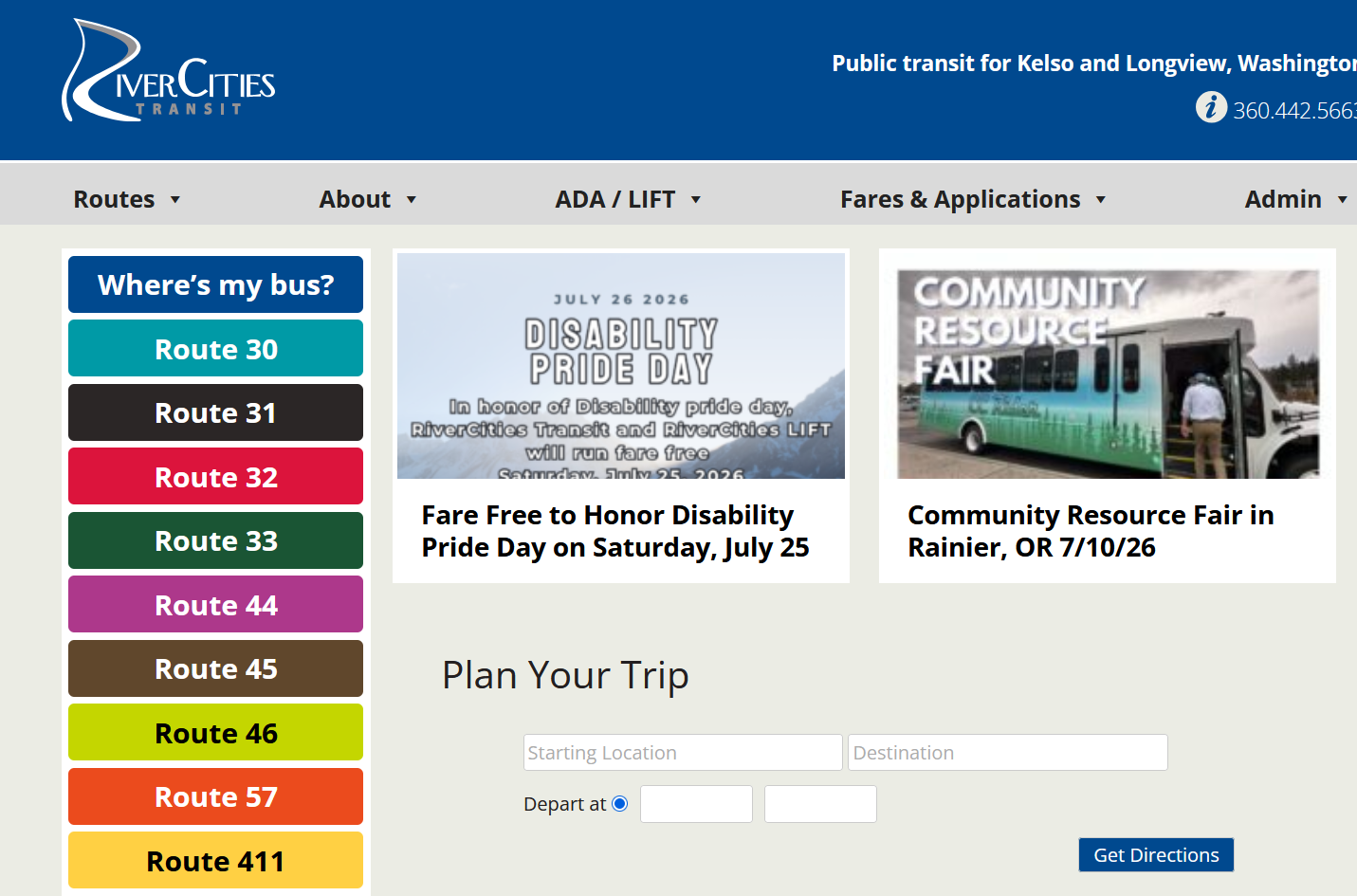
I mean just look at it. I love it. Alive internet theory. Beyond being incredibly useful and providing all of the exact details I needed to plan this trip, local transit websites are just. Chefs kiss, web design is my passion, either objectively well designed or so, so endearing you can't blame them for making you rotate your head ninety degrees to read the extremely jpeg compressed schedule.
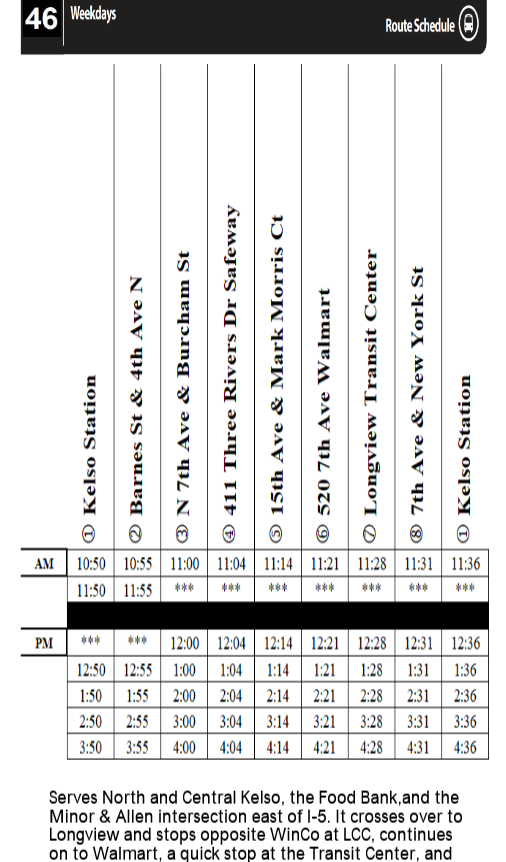
Magnificent.
Anyways, Google maps has this fun feature beneath every transit line, where they list the website they source their information from.
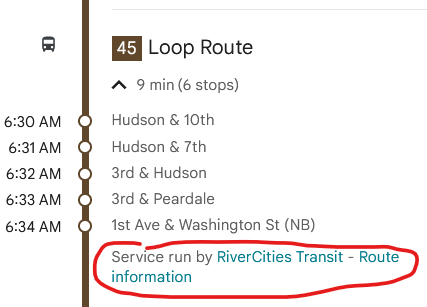
So as I went along, I simply clicked through and enjoyed myself as I was whisked away on a journey of what the web could have looked like if it wasn't being actively ruined by a doomsday cult of tech oligarchs. Life could be a dream.
Except life wasn't a dream because I realized I fucked up detrimentally. Remember when I mentioned earlier that this was over the holidays? I'm sure someone reading this correctly predicted my massive fumble, but I forgot about holiday hours. So I start frantically Google mapsing, my hope increasing with each search, as it didn't seem any route had changed hours. It wasn't a major bank holiday, so for a brief moment I was convinced I'd gotten away with it. And then, good old River Cities hit me with this.

Shit.
The 511 simply did not run on the day I intended to leave. The second to last bus, and one of the longest stretches, connecting me between Longview and 99th street. I would either have to break the rules by getting a very spendy Lyft between stops, or I'd have to delay my trip a day in order to ride the usual weekday schedule.
This was punishment for my hubris, but unfortunately, my hubris is a masochist, and I know someone with a car. So I simply shifted some things around. Instead of heading from Seattle to Portland by bus, then returning by train, I would drive down with someone, and do the original route, returning via bus instead. You might note that this means my current schedule is now in reverse. I also noted this, and proceeded to pull a Missy Elliot, flipping it and reversing it.

This was the new route. I cut off the final bus because there wasn't any physical way for me to travel from where I was staying in Portland to the 105x in time for this route to work. I still feel a little bad about it, it was absolutely a cop out, but ultimately I set out on this trip both to have fun in Portland, and to dip my toes into the water of transit based challenges. Think of it this way, when I inevitably do attempt Seattle to San Francisco, I will be sure to book a place to sleep that is near to the bus I need to take in the morning.
It's worth noting, I played around with this route a lot. This was not the only iteration I made, and at one point I explored the idea of lengthening the trip to make it a coastal tour across multiple days, but I rightly decided against it. I didn't have enough time to enjoy those smaller cities as much as I felt they deserved to be enjoyed, and if I messed up a connection I would risk fumbling multiple hotel reservations in rural Washington and Oregon, which was too much of a risk for me. For prosperity, here was the draft of my weird costal trip, deviating from OTC. Maybe I'll come back to it when I have more time, maybe you'll find it useful, who knows.

At this point, I had the entire trip planned out a month in advance. Now all I had to do was execute it.
We Ride At Daybreak
I celebrated Lunar New Year with my brother, saw the inside of a submarine, cooked and ate two whole trout, and got a ride to my first bus stop as the sun began to rise. Normally, I would have taken the 105x from downtown Portland, but my brother did not live in downtown Portland, and there were no buses running early enough to make it in time to catch the first 105x. I had chugged a can of coffee, gathered my things, and hopped into the car for a half-hour drive to the 99th street transit center in Vancouver, Washington. I asked him a hypothetical about the moon being made of cheese, because of a sci-fi book I planned on reading. We discussed this at length, discovered Vancouver doesn't have bathrooms at its transit center, and then I was waiting in the young morning light for the 511 to Longview.
This would be my first official bus of the route. I was a little nervous. The prior day I had run into Ranch 99 for dinner supplies, and to pull out twenty dollars in one dollar bills. It was overkill, I admit, but I figured it would be useful to have a few extra ones on me just incase.
I waited for maybe ten minutes, and a short bus came rolling to a stop. It had, maybe, room for fourteen passengers generously, clearly some sort of repainted school bus—an olive green, instead of yellow—the seats were all that same leather, all of them faced the front. I was standing there with two other people by then, from context about their conversation, and their backpacks, I think they were students. Maybe high school or college age. They were friends, probably because they have to take this small bus as a commute to who-knows-where.
I say this because the bus driver was familiar with them as well. They were regulars, they got on before me, and took a seat in the middle, while I shoved three dollars into a clear plastic bucket, and sat near the front. I said no to a transfer because I, unfortunately, assumed we'd be traveling out of range for that—turns out I was wrong and my next bus was River Cities as well, so I could have used that transfer, but that's why I got the extra one dollar bills.
The bus driver was this nice lady who loved to talk, which was great, I was trying to preserve phone battery. She was asking the two students about school, how they were doing, any life updates. They were all very familiar, and I felt a little bit strange as I sat there tired, a complete stranger. Either way we pulled off and so began the nearly one hour journey. The highway was surrounded by trees, but not evergreens. It was winter, and all of them had lost their leaves, making for a dreary ride through muddy, grey valleys, and dead woodland. It was foggy once we got far enough out, distant hills looked like ghosts. The heating on the bus was working overtime. Like any repurposed school bus, it was rattly. Hard to hear a lot of the conversation clearly, but I could pick up on most of it well enough to peace together the context.
Mostly small talk. That was, until we pulled off the highway at one of a handful of stops. It was in the parking-lot of a casino. Not one I'd ever heard of before, not like Emerald City or any of the big ones. That much was clear because it was a six story building smack in the middle of absolutely nowhere, there were two massive, empty parking lots, and one road which lead either back to the highway, or further into the trees, I presumed there must have been a town nearby. I couldn't see any other buildings, though.
We pulled into one of the lots. The driver made it clear that technically she wasn't supposed to do this, it was not an official stop, but she did it anyways because she preferred it, and we were ahead of schedule. So we idled there for a while, and she talked some more. Eventually the doors opened and one man climbed on. He was chatty too, coming from the casino, but they didn't seem to know each other.
As we pulled away, the conversation shifted from small talk. I found out the bus driver had a farm, and she'd been clearing some of the trees off her land with a chainsaw. She'd been trying to convince her teenage daughter to help out, but she was more interested in other things. The bus driver confessed she liked to pick up hitchikers in her spare time, which seems pretty on the nose for a bus driver. She then continued to confess that she wished she could pick them up on her bus, too, but dispatch didn't like when she did that. The conversation shifted once more to the subject of firefighters, for some reason, and the bus driver told us about a time she hit a deer. She got out of the car to find it was still alive, and called the fire department to help figure out what to do with it. They ended up killing it, and one of the firefighters lugged the body back to their truck.
She asked them what they were gonna do with it. They said they were gonna eat it, probably.
The man from the casino was mournful that he hadn't been saved by firefighters yet. He thought they're hot (no pun intended).
They talked about cars a bit, and after a while conversation died down. I enjoyed the rest of the ride, wondering what else was going on in rural Washington.
The Safeway at the End Of The World
The 511 dropped us off at River Cities Transit Center. The students left a few stops ago in a different town. The casino guy stuck with us the whole way, along with a few other people we picked up from here and there. Longview was…not forgettable, but not particularly much of anything. There was not a single building taller than two stories, most decided that one is enough. The sky was overcast, everything was wet, but it wasn't actively raining, so it didn't feel earned. It was early enough that there was nobody else outside except those of us waiting for the bus, storefronts were dark. It was a ghost town. I tried not to judge Longview based on my brief passing through it, but it was the sort of town I imagine most people want to leave the moment they turn 18.
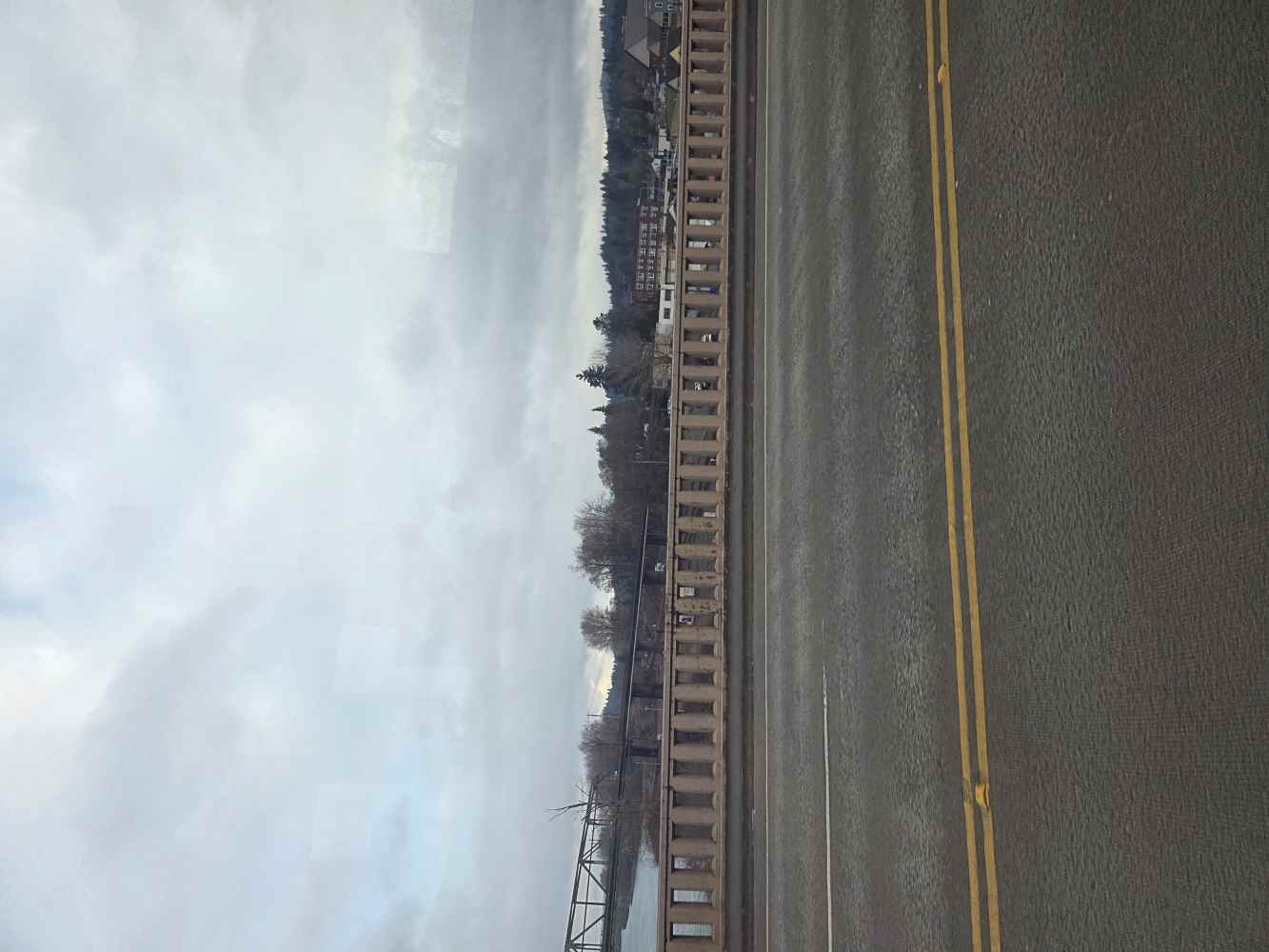
A regular sized River Cities bus took me and a handful of other people on the 45 loop. We crossed a bride over the Cowlitz River—apparently this river is the reason why Kelso, the city adjacent to Longview, is known as the "Smelt Capitol of The World". You can form your own conclusions about what that means.
I depart at the Safeway. Yes. The bus stop is literally just 'The Safeway Bus Stop'. I was also wondering what this meant, and it was self explanatory. It was a Safeway. Perhaps the most esoteric Safeway known to man. I need to emphasize this. Yes this Safeway was in Kelso, which is a city. No, you would not be able to tell that.
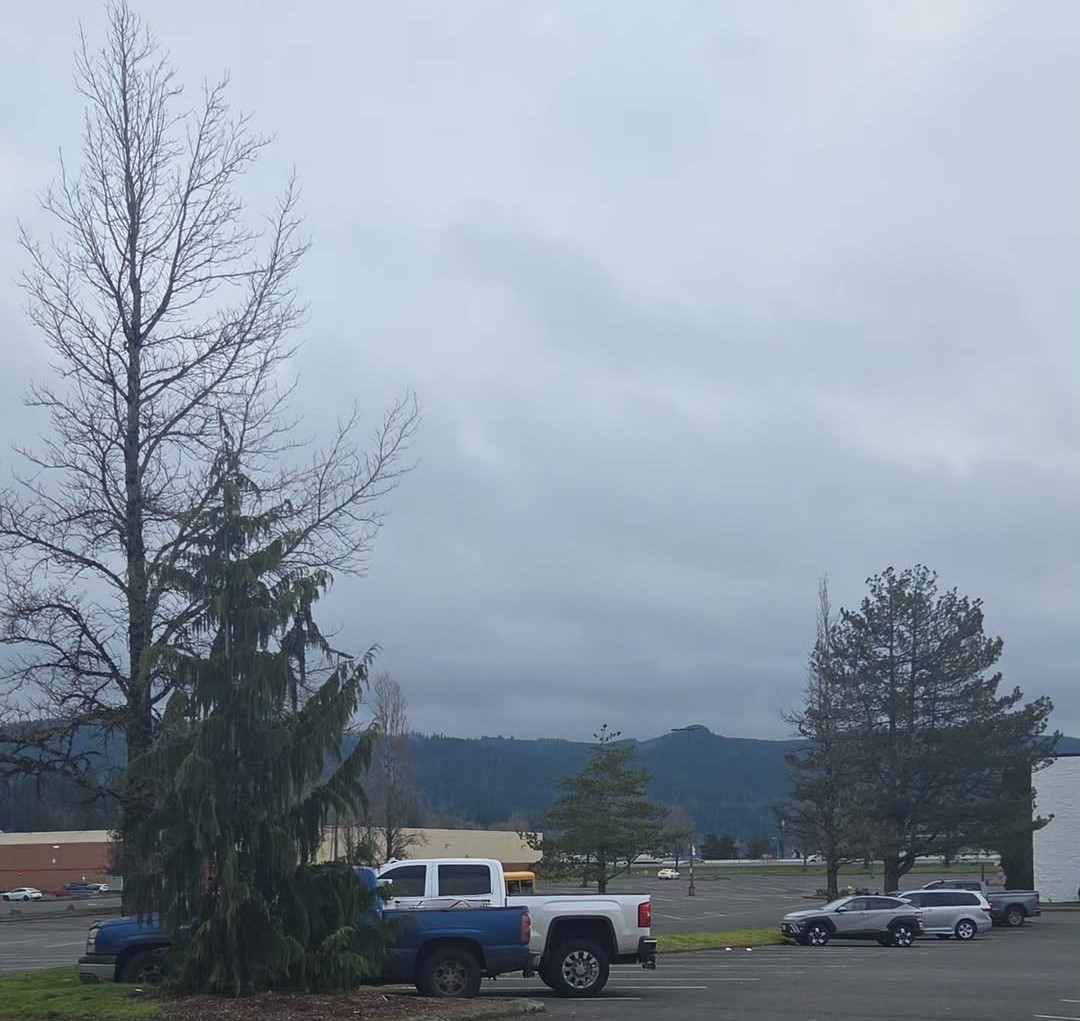
A majority of the land space was taken up by parking lot. This seems to be a common theme in rural urban planning. (Side note: that term feels weird. Rural urban planning? Would it just be rural planning? I don't know, but you get what I mean, I hope.) It was the same at the casino, the primary difference was the size, it was bigger by quite the margin. The view was incredible, though, mountains enclosed this Safeway and the mall it was in, the true manifestation of that meme—wow this place would be perfect for a Walmart.
This was one of the longer waits on this trip, I would have stepped inside the Safeway for breakfast, as at this point it was nine in the morning, but I was worried I might somehow miss the bus. See, this bus was not a bus. It was a van.
I'd watched many videos of this route in practice for the day itself, and in all of them, the single most jarring thing was this bus route, because again, it is a van. A van with some seats bolted into the back of it. You tell the driver where you're going, and off you go, down the route. It was just unusual enough that I wasn't sure what to expect, and much as my schedule had served me well thus far, I was a little too nervous to risk spending however long inside of the Safeway. This bus only came once every two hours, so if I missed it, it would be sort of a big deal. This was also my first proper change in operator, I was no longer in River Cities jurisdiction, I would be riding with Lewis County for a while.
So I stood there outside the Safeway. A couple joined me, older and grumpy looking. They kept glancing at me, I probably looked and smelled crazy. I tried to ignore them, and hoped they would ignore me.
The van pulled up, and a man leaned out the window—the bus driver—he told us he was going to circle around, and that it would be a little bit. We all nodded, and he left for about ten minutes, then came back to pick us up. He asked where we are headed as we clambered on. This bus was the first free bus of the route, Lewis County, I love you. There wasn't enough room in the van for a money taking machine or plastic bucket anyways.
Unlike the first ride, this one was quiet the entire way, the bus driver was diligent, the couple wasn't very chatty, not even with each other, and the ride itself was quiet. In fact, I'd argue the van was the smoothest ride on the entire trip. I tried to get some reading in—Hitchikers Guide to the Galaxy, because I am nothing if not on brand—but I got motion sick halfway through, so I put on a podcast instead.
Pulses, More Parking lots, and getting lost in Olympia
The Purple line runs from Safeway to the Mellen Street Transit Center. This is a generous term for (I'll let you take a wild guess as to what I'm about to type next) a parking lot. It came to a stop in the middle of the pavement, not near any platform. We all got off and waited in what ammounted to a small concrete square in the middle of some grass off the side of the highway. Mellen Street Transit Center has a secret though, it may look rough, but it has one of the most meticulous and essential pulses I've ever seen.
For some context, a pulse is a scheduling tactic—sometimes unintentional, often very intentional—wherein multiple buses arrive in the same place, at the same time, for flawless transfers. This happens in large transit hubs, with the intention of making it so you can reliably hop off one bus and straight onto another, and it is essential if your transit center, like Mellen Street, has nothing anywhere nearby.
For middle-of-nowhere places like this, it's important to time things correctly, otherwise you'll have a bunch of people stranded for however long it takes rural busses to run their very very long routes. Like I mentioned, the purple like only comes every two hours. Mellen Street has this down to a science. It seemed as if they'd timed it so every single bus servicing the transit center arrived at the same time, and left around the same time.
To the point that, as I got off the purple line, we had to wait around for all the other buses to arrive before we could get on the green line to Olympia. The green line was, thankfully, not a van, but it was another short bus. As I stood there waiting for the bus driver to get back and let us on, I counted the other people waiting with me. There were a lot of them. For a moment I was a little scared I might not fit onto the bus, after all, there were only so many seats, and these routes probably aren't used to someone like me doing something as stupid as this.
Thankfully, it was all fine, we filled up the bus exactly, not one seat left empty. Someone behind me noted that it was the most full he'd ever seen the bus.
We took off towards Olympia, where the rural leg of my trip would officially end, and I'd be going straight from Olympia to Seattle, with one stop at a park and ride outside Tacoma. It was also the last time I got to eavesdrop on people. The guys behind me were having a rigorous discussion on theoretical physics. Someone else was heading to Olympia because their mom had a stroke, and they had to take care of her. I kept switching between the two, getting conversational whiplash. At some point we passed a billboard that said 'LEAVE TRUMP ALONE' and I wanted to ask whoever put it up if they thought being the President was some kind of private ordeal.
Finally I arrived in Olympia. At that point I was thinking I'd conquered the most difficult parts. The transfers from there on out were easy enough, I only had two more buses before I could take the light rail the rest of the way, and by then I would be in familiar territory. My hubris again betrayed me, because the Olympia Transit Center was, apparently, harder for me to navigate than the esoteric Safeway, or the van, or the casino I'd never heard of. I was meant to be taking the 610. I looked at the signs, all of them. The maps. Everything, it was not there. I checked Google maps, and there it was, allegedly it was meant to be right where I was standing.
This was not a long transfer, I had twelve minutes to figure this out, and I had spent a good four of them wandering around the platform like a chicken without its head. It did not help that the GPS on my phone couldn't decide what direction I was facing. After a while of frantic searching, however, I discover the truth.
The 610 was on the other side of the transit center, and I was looking a fool.
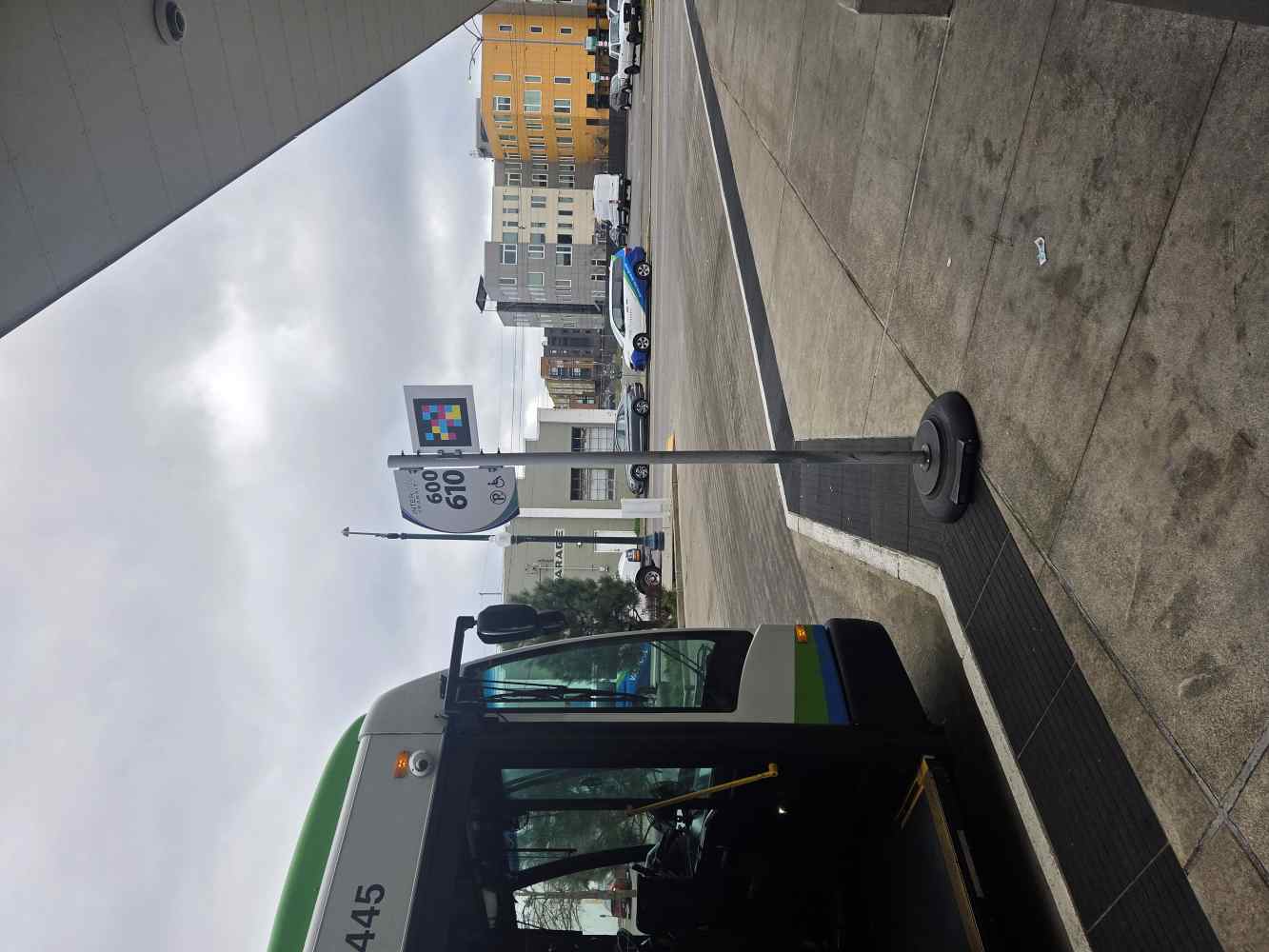
To be fair, this setup was strange. It was the only bus stop on this side of the transit center, and it wasn't visible from the opposite side as there was a giant building in between. It wasn't clearly listed on any of the maps (or I was too exhausted to notice if it was) and Google maps isn't detailed enough to point out that it's on the other side of a relatively small concrete island.
Luckily, I found it with a few minutes to spare, and took a seat near the back. I was the only person on this full sized bus, so I cracked open my second can of coffee for the day. Oh yeah, and this bus was also free. Thurston County I love you.
The Final Leg
The 610 takes you on a fun tour of Olympia. I should mention, Olympia is the capitol of Washington, so the architecture is obviously amazing. I didn't get any good photos of the capitol building, but I did snap a few blurry shots of the courthouse.
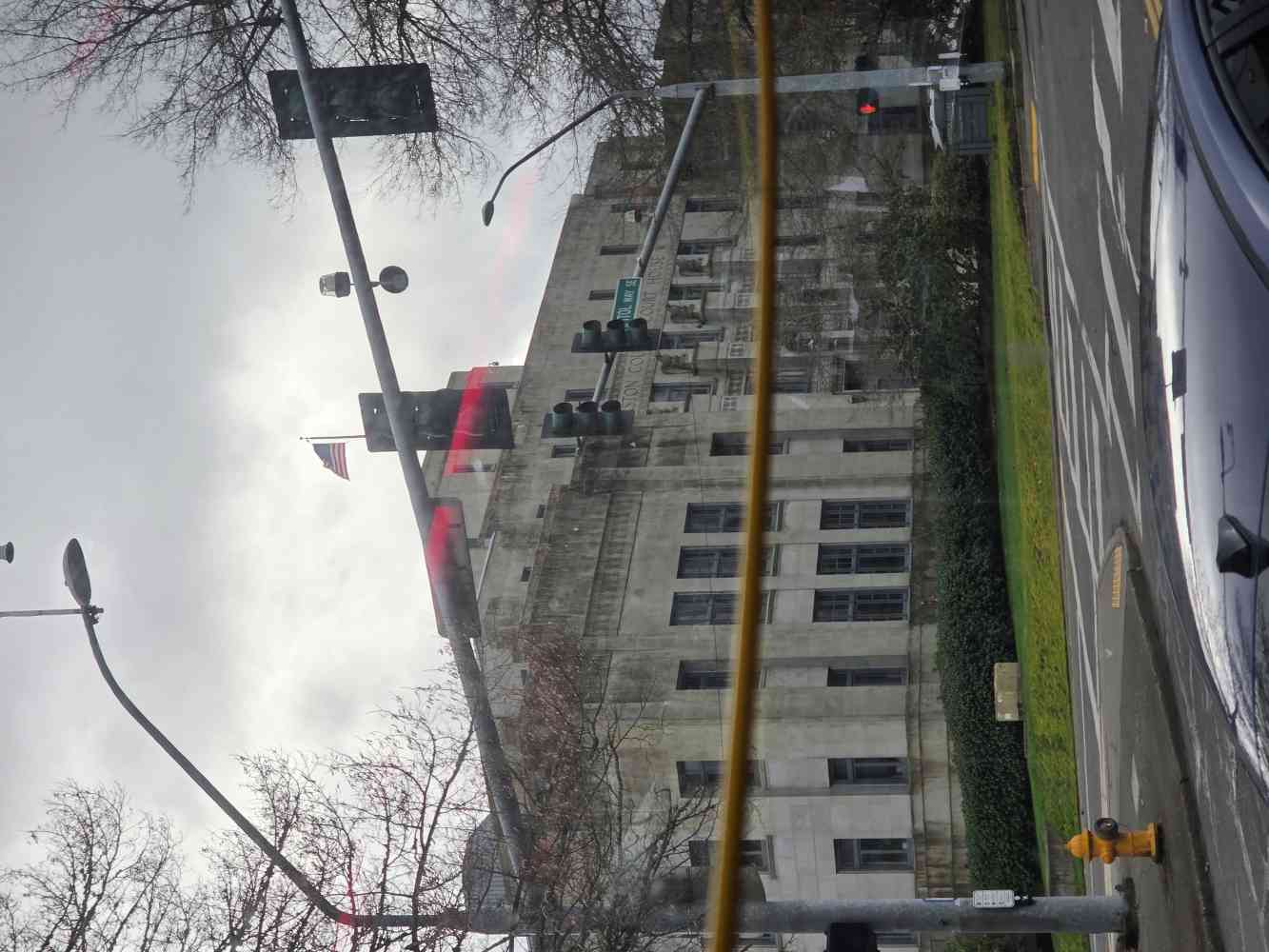
I've been to Olympia a few times but always in passing on the way to or from Portland, and never as a proper trip. I spent all my lovely twelve minutes there in a panic to find the 610 bus stop. Thank you Olympia, I wish I had more time to appreciate you.
We hopped back on the highway, I sipped my coffee, and took note of how strange it felt to return briefly to the world of buildings in the middle of the woods. How beautiful a testament to human persistence that there were dispensaries. Otherwise, I'm bracing myself for the longest pause between bus' of the trip, and at a place with not much to do. I'd be sitting around for 26 minutes in a park and ride, that was fine, I'd sat around for longer in less ideal locations. As I scrolled for podcasts to keep listening to, we pulled into the park and ride. I looked up.
There it was.
My next bus was sitting there, the 594, right there. I mentioned pulses earlier, well, sometimes a transit authority is evil and does the opposite of this. For some reason King County does this fun thing where the busses at a transit center leave as soon as the other arrives, meaning you are almost always guaranteed the longest possible fucking wait known to man (15 minutes) no matter what you do. The 594 was a Sound Transit bus, and 610 was a Thurston County bus, so there was a good chance they hadn't synced up their schedules, and I would watch as the perfect connection slipped through my fingers.
I wasn't convinced until I booked it across the transit center, paid my three dollar dues, and sat in a seat near the middle, facing a Sound Transit sign, that I had done it.
This was the last bus of my trip, and I'd managed to grab it early. I couldn't tell if I was just lucky enough that the timings were off in my favor, or if I had miscalculated the transfer in my spreadsheet, but it didn't matter. In an hour and a half, I'd be back in Seattle.
We blew past Tacoma, the Tacoma Dome welcoming me back into Northwestern Washington. Soon, we were in Sodo, and I hopped off a little early so I could run into the sweet loving arms of the LINK. As fun as the trip was, it was nice to be back where I could navigate without looking at a map or a schedule every five seconds. I was hungry, so I jumped off in the International District for a bite. I looked at the time. I was a full hour early.
As I stepped onto the platform, from the gaps in the ceiling, snow began to fall.
Post-Trip Thoughts
I've claimed for a long time that Seattle—and Washington as a whole—has some of the best bus-based public transit in the country. Our light rail might be young, now with only two lines, but our bus routes are robust, frequent, and relative to other cities, quite timely. It's always an exception to the rule for a bus to be egregiously late, and the one problem route in our city is such a big deal, that there is/was an entire movement to get the city to do something about it. We take out buses personally.
Our current mayor was a member of the transit riders union. The tunnels beneath our city were originally dug for buses in the 1980s, only later adapted for the light rail in 2009. For a city as big and busy as Seattle now is, compared to other major metropolitan areas, our buses are actually pretty fucking good. We complain a lot, but that's human nature I guess.
Seattle is still a city. It has the funding, and the infrastructure, and the leadership to afford the luxury of comprehensive transit. Metrics start to fail once you venture to less populated, less wealthy parts of the state—this is a universal constant. Large cities often have much better transit than rural areas and smaller towns. It's all a matter of resources, but it's also a matter of accessibility. A lack of comprehensive public transit in rural areas disables people. If you can't drive a car for whatever reason, you either need to know someone who does, and rely on their generosity, or you need to rely on inherently unreliable public transit. Sometimes you might not even have the option of public transit at all.
Part of this adventure was prep for something longer, part of it was for fun, and part of it was to see for myself what rural transit could be. I'll be the first to admit that while some of these places were small, they weren't the most rural places in Washington. I stuck to the west coast. Head any further east and your prospects dwindle greatly, you can't get across the boarder into Idaho without booking a ticket on a charter bus, and getting anywhere from Spokane besides Seattle is a disaster waiting to happen. Washington as a whole is not perfect when it comes to this, and western Washington enjoys quite a few privileges in this regard, but it is still pretty damn impressive.
I got from Portland to Seattle in under 8 hours, if I had taken the transfer for River Cities, I'd have done it for less than six total dollars. A ticket for a three to four hour Amtrak ride can range from eighty dollars to the mid-hundreds depending on how early you book. The bus trip not easy to do, don't get me wrong, but if you're on a tight budget, and have the time, this is both possible, and affordable.
Even that I can hop on two busses and be in Olympia within the day is impressive to me. We have the Sounder as a commuter train, of course, but that terminates in Tacoma. Unlike the east coast of America, our train game is lacking, but we make up for it with our buses. I'd still love more commuter trains, obviously, and more light rail routes, but that's become a controversial topic as of late. Budgets are such a killjoy.
I think before I brave the wilds of California, I might explore more of what Washington has to offer. If I do, I'll blog about it eventually. I never know how to end these things.